
Building a Home Cigar Lounge: Ventilation to Wall Art
Share
Start with the air. Everything else in a home cigar lounge is comfort, but ventilation is what decides whether the room stays a lounge or becomes the reason nobody else in the house comes downstairs. Get the airflow right and the rest is just decorating. Get it wrong and no amount of leather seating fixes it.
Most people build this backward. They buy the chairs, hang the art, sit down for a two-hour smoke, and discover a week later that the smell has moved into the drywall and taken a lease. Build it in the right order and you never have that conversation.
Air Handling Comes First
Smoke needs somewhere to go, and "the rest of the house" is not an answer. You want negative pressure in the room: more air leaving than entering, so smoke gets pulled out instead of drifting under the door.
The cheap version is an inline duct fan vented outside, sized somewhere around 6 to 8 air changes per hour. For a 12-by-14 room with 8-foot ceilings, that's roughly 130 to 180 CFM. Mount the exhaust high, since smoke rises, and give yourself a fresh-air path low on the opposite wall so the fan isn't fighting a sealed box. A gap under the door works. A small passive vent works better.
Skip the tabletop smoke eaters as your primary solution. They filter particulates and do almost nothing about odor, because odor is gas, not dust. They're fine as a supplement once the exhaust is doing the real work. If you're renting or can't cut into an exterior wall, a window fan in a properly sealed insert is a legitimate stopgap, and it's what plenty of good home lounges run on.
Seal the Room, Then Pick Your Surfaces
Once air is moving the right direction, close the leaks. Weatherstrip the door, add a door sweep, seal outlet and switch boxes with foam gaskets, and caulk any gap where a pipe or duct passes through. This costs about forty dollars and does more for household peace than anything else on the list.
Then think about what's in the room, because smoke has a memory and soft goods are where it lives. Carpet, upholstered fabric, curtains, and unfinished wood all hold odor for months. Leather, vinyl, tile, sealed hardwood, glass, and steel do not. That's not an aesthetic preference; it's the reason cigar lounges have looked the way they've looked for a hundred years.
You don't have to strip the room to concrete. Just make the big surfaces hard and let the small ones be soft. A leather chair on a tile floor with a steel sign on the wall reads as intentional. It also airs out in an hour instead of a season.
Lighting Built for a Two-Hour Sit
Cigar rooms fail under overhead lighting. A single bright ceiling fixture flattens everything and makes a lounge feel like a waiting area. You want light in layers, low and warm.
Aim for 2700K bulbs, dimmable, at three heights. A floor lamp beside each chair for reading a label or a book. Something over the bar surface so you can actually see what you're pouring. And a low accent light, picture lighting or a small wall sconce, aimed at whatever's on the wall. That third layer is the one people skip, and it's the one that makes the room look finished at night. If you're already running conduit for the exhaust fan, run a switched circuit for the accent light at the same time and save yourself a second job.
Seating: Fewer Chairs, Better Chairs
Four good chairs beat eight mediocre ones. A cigar sits between forty-five minutes and two hours, and the chair has to survive that without anyone shifting around. Real leather or high-grade vinyl, a firm seat, arms at a height where you can hold a glass without your shoulder working for it.
Angle them toward each other rather than toward a screen. A cigar lounge is a conversation room, and the furniture layout tells everyone that before anyone says a word. Put a side table within reach of every seat, because an ashtray you have to lean for is an ashtray that ends up on the floor.
The Wall Is What People Actually Remember
Here's the part that gets treated as an afterthought and shouldn't be. Once the air moves and the chairs are right, the room still needs to say something. A blank wall over a bar shelf makes a nice setup look temporary, like you're between projects.
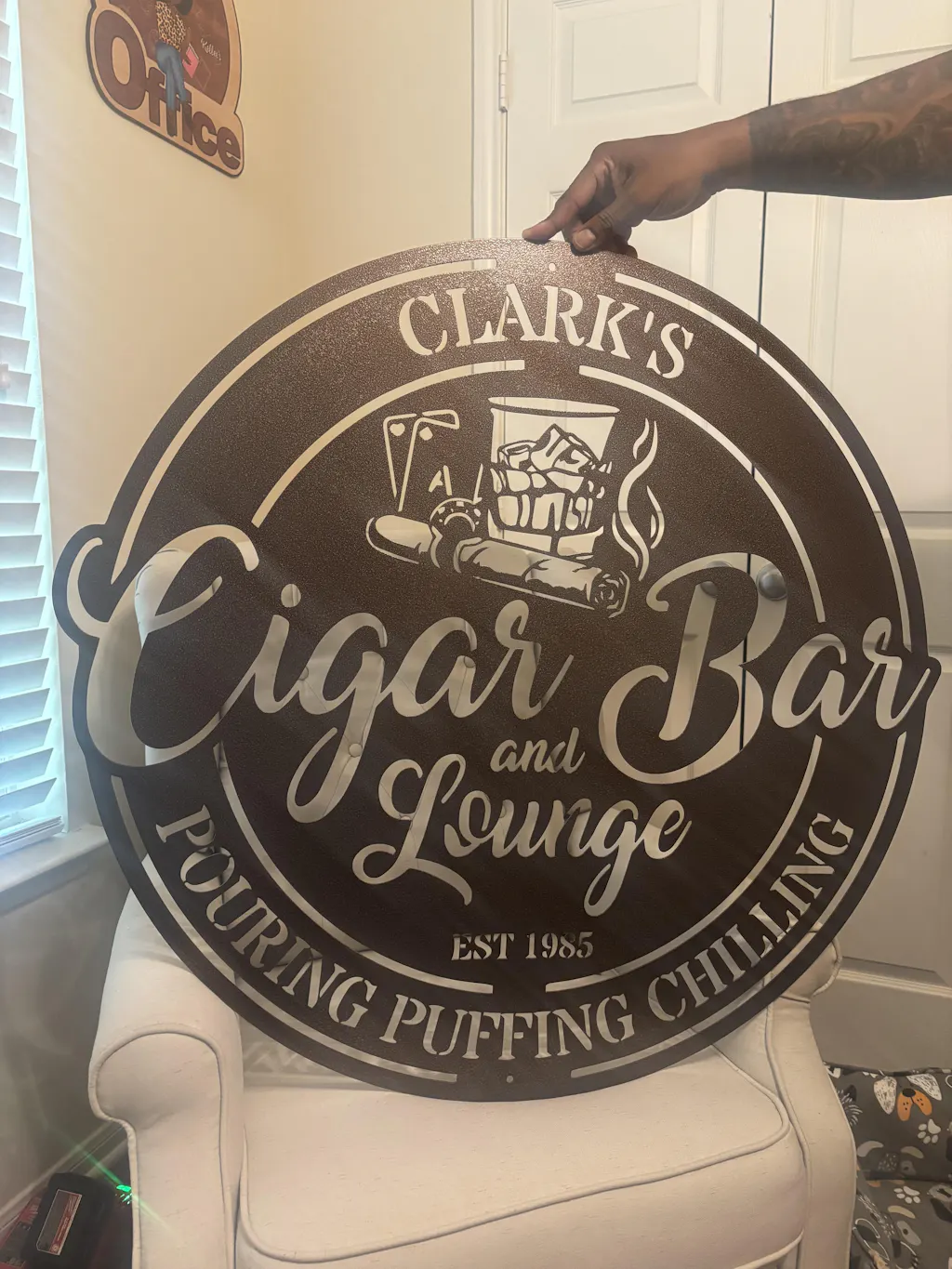
Steel is the natural material here for the same reason it's the right pick for the rest of the room: it doesn't absorb smoke, it wipes clean, and it holds up under heat and humidity swings without warping or fading the way a print does. A personalized cigar bar and lounge sign with your name on it turns a spare room into a named room, which is a bigger psychological jump than it sounds. A Cigar Bar Lounge steel sign does the same job with a bit more swagger. If the space pulls double duty as a whiskey room, the Whiskey Glass with Ice and Smoking Cigar wall art covers both halves of the ritual in one piece.
Hang the main piece at eye level from a seated position, not a standing one. You'll be looking at it from a chair for most of its life. See the full Man Cave Signs collection →
The Build Order, Short Version
Exhaust fan and fresh-air path. Seal the room. Hard surfaces on the big planes, soft ones on the small. Layered warm light. Four chairs that hold up for two hours. Then the wall.
Do it in that order and you get a room you can use every week. Do it backward and you get a very handsome space that nobody's allowed to smoke in.