
How to Read a Bourbon Label Like a Pro
Share
A bourbon label isn't marketing dressed up as information. Most of what's printed on the front is defined by federal law, which means once you know the vocabulary, the bottle tells you how it was made before you spend a dime. Learn six or seven terms and you'll walk the aisle reading bottles the way a mechanic listens to an engine.
Start With the Word "Straight"
"Straight bourbon" is the phrase that does the most work on any label. It means the whiskey was aged at least two years in new charred oak with nothing added: no coloring, no flavoring, no sweeteners. If a straight bourbon is younger than four years, the label has to say so with an age statement. If it doesn't carry one, you're looking at something at least four years old.
Plain "bourbon" without "straight" can still be good, but the guardrails come off. It might be blended with other spirits or carry additives in some cases. When you see "straight," you're getting the real thing with no shortcuts, and that's the baseline worth starting from.
Proof Is the Number That Matters Most
Proof is double the alcohol by volume, so 90 proof is 45% ABV. Every bourbon leaves the still strong and gets cut with water before bottling, and the number on the label tells you how much cutting happened. Standard bottlings land around 80 to 100 proof. Anything labeled "barrel proof" or "cask strength" skipped the dilution entirely and can run past 120.
Higher proof isn't automatically better, but it does mean more concentrated flavor and more room to adjust in the glass. A few drops of water on a barrel-proof pour can open it up dramatically. Reading proof first tells you fast: is this an easy weeknight sipper, or something that needs a little respect?
"Bottled-in-Bond" Is a Guarantee, Not a Flavor
If a label says "bottled-in-bond," it's making four promises at once: the whiskey is the product of one distillery and one distilling season, aged at least four years in a federally supervised warehouse, and bottled at exactly 100 proof. That standard comes from an 1897 law written to stamp out fraud back when "whiskey" might have been anything.
For you, it works as a shortcut. Bottled-in-bond means real age, honest strength, and a single source, usually at a price that punches well above its weight. When you're not sure what to grab, a bonded bottle is one of the safest bets on the shelf.
Age Statements and the Ones That Go Missing
An age statement always refers to the youngest whiskey in the bottle, never the oldest or the average. A "6 Year" bourbon might hold older barrels in the mix, but nothing in it is younger than six. That's why age tells you less about quality than people assume and more about style.
Plenty of excellent bourbons carry no age statement at all, which just means the youngest whiskey inside is at least four years old. Don't treat a missing number as a red flag. Treat older-than-usual numbers, like 10 or 12 years, as a hint that you're paying for extra time in the barrel, and decide whether that oak-forward profile is what you actually want.
Who Actually Made It? Read the Fine Print
This is where labels get sneaky. "Distilled by" means the company on the front actually made the whiskey. "Produced by," "bottled by," or "crafted by" often means they bought it from a large distillery and put their own name on it. Sourced whiskey isn't bad, some of it is excellent, but you should know when a premium price is buying a story instead of a still.
The tell is the state of distillation, which the law requires somewhere on the bottle. If a brand markets itself as a scrappy local operation but the small print says "distilled in Indiana," you've just learned something the front label was hoping you'd miss. This one habit alone will change how you shop.
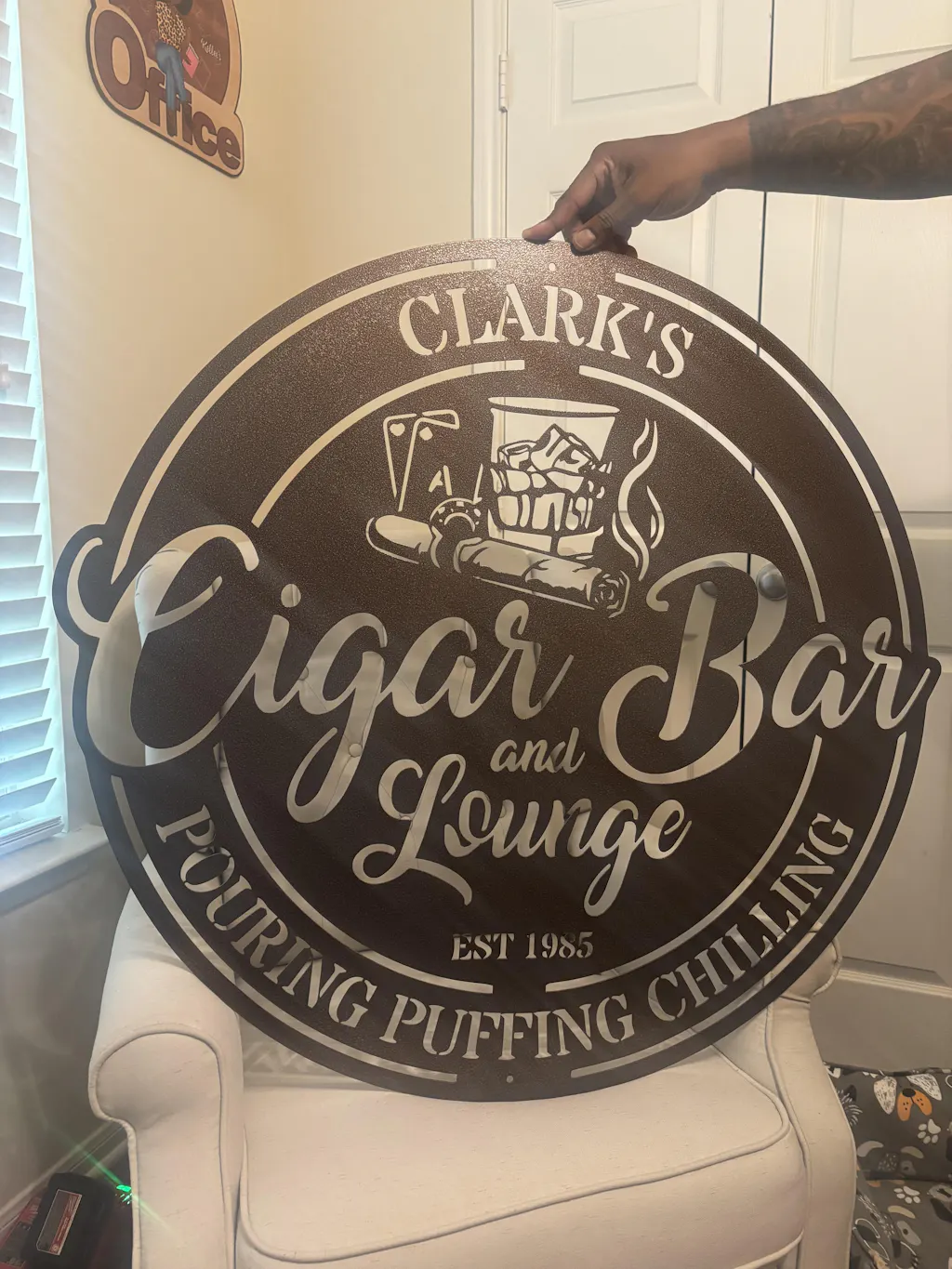
If you're building a shelf worth showing off, the wall behind it deserves the same attention as the bottles. A laser-cut steel Glencairn or whiskey bar sign turns a row of bottles into a real focal point. Browse the man cave and bar sign collection and give your pours a backdrop.
Single Barrel vs. Small Batch
"Single barrel" means every drop in that bottle came from one individual cask, so it was never mixed with anything else. Because no two barrels age identically, single barrels vary bottle to bottle, which is part of the fun for people who chase them. Many carry the actual barrel and rick-house numbers handwritten on the label.
"Small batch" sounds similar but is far looser. It has no legal definition, so a small batch could be a blend of a dozen barrels or several hundred, depending on the distillery. It usually signals a more curated, consistent product than the standard line, just don't read it as a hard promise of anything specific.
The Words That Mean Nothing
Some label language exists purely to sound impressive. "Handcrafted," "artisan," "small batch" (see above), "old-fashioned," and "founder's reserve" carry no legal weight whatsoever. A distillery can print them on anything. They're mood lighting, not information.
Focus on the terms that are defined and skip the ones that aren't. Straight, proof, bottled-in-bond, age, state of distillation, single barrel: those six tell you almost everything worth knowing. The rest is packaging.
Putting It All Together
Next time you pick up a bottle, run the checklist. Is it straight? What's the proof? Is there an age statement or a bonded stamp? Where was it actually distilled? In about ten seconds you'll know more than the marketing wants you to, and you'll stop overpaying for pretty fonts and empty adjectives. The label was telling the truth the whole time. You just needed to know which words to trust.