
Outdoor Whiskey Spaces: Patios, Pergolas, and Weatherproof Decor
Share
An outdoor whiskey space lives or dies on one question: what happens to it in November? Everything else is styling. Get the materials right and you'll pour outside nine months a year. Get them wrong and you'll spend every spring hauling swollen particleboard to the curb and pretending you meant to redesign anyway.
So let's build the version that survives.
Start With the Pour, Not the Furniture
Most people shop for a patio bar before they've figured out how they actually drink outside. Bad order. Sit in the space some evening with a glass and pay attention.
Where does the sun hit at seven o'clock? Nobody wants to nose a bourbon while squinting into a sunset. Where does the wind come from? A steady breeze scatters aroma, which is the whole reason you're holding a Glencairn instead of a coffee mug. Where do people naturally cluster, and where does the conversation actually happen?
Nine times out of ten the answer is a corner, not the middle of the deck. Corners give you two walls of shelter, an anchor for a vertical surface, and a reason for people to gather instead of drift. Build there.
The Pergola Is Your Ceiling, Wall, and Wall Space
A pergola does three jobs at once, which is why it beats a patio umbrella for anything permanent.
It gives you shade you can tune. Slats overhead cut the glare without turning the space into a cave, and a retractable canopy across the top buys you another six weeks on either end of the season. It gives you enclosure, that subtle psychological signal that you've walked into a room rather than a yard. And most usefully, it gives you posts and beams. Vertical surface. Somewhere to hang the things that make the space feel like yours.
That last part is what people forget. A bare pergola is a carport. A pergola with a sign, a light, and a shelf is a bar.
If you're building new, size the posts up one dimension beyond what the span requires. Chunkier posts look intentional, hold hardware better, and give you a real surface for mounting decor. Six-by-sixes over four-by-fours, every time.
Materials That Actually Survive Outside
Here's where the money either works for you or evaporates.
Steel and aluminum. Powder-coated steel is the workhorse. It handles UV, rain, and freeze-thaw cycles without warping, and a laser-cut steel sign will look the same in year eight as it did in week one. Aluminum won't rust at all, which matters if you're coastal.
Teak, ipe, and cedar. These are the outdoor woods worth paying for. They gray gracefully rather than rotting. Pine will not do this. Pine will do the opposite of this, loudly.
Concrete and stone. For bar tops and counters, nothing beats sealed concrete. It's heavy, it's cold, and it doesn't care about a spilled Old Fashioned.
Things to skip. MDF, laminated anything, untreated plywood, paper-backed prints, and any "outdoor rated" item that's really just an indoor item with a sticker. If a product's water resistance depends on a coating you'd have to reapply, you're signing up for a chore.
The rule of thumb: if you'd feel fine leaving it out during a thunderstorm, it belongs outside. If you'd bring it in, it was never outdoor decor.
Wall Art That Won't Quit
A patio bar with nothing on the walls looks unfinished no matter how good the furniture is. Outdoor spaces need a focal point even more than indoor ones do, because there's so much open sky competing for attention.
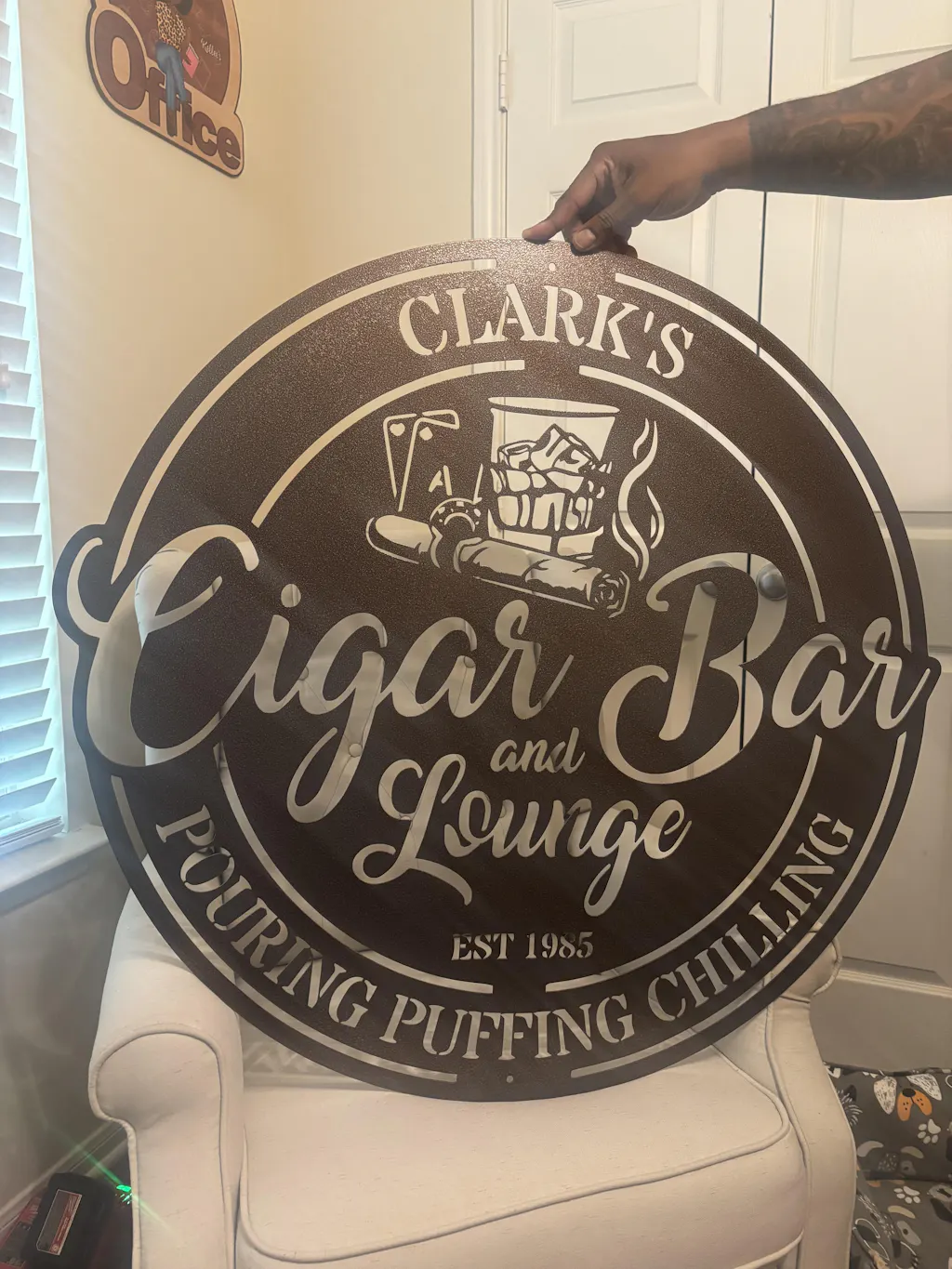
Metal is the obvious answer. A powder-coated steel sign mounted on a pergola post or a fence panel reads clearly from across the yard, throws a great shadow in late-afternoon light, and shrugs off the weather that would destroy a framed print in a single season. Personalized pieces work especially well outside because they answer the question guests are already asking: whose place is this, and what happens here?
Browse our outdoor metal signs →
Mount at eye level for someone standing, not sitting. Outdoor spaces are standing spaces most of the night. And leave a little breathing room around the piece; a sign crowded by string lights and hanging plants loses all its authority.
Light It Like a Bar, Not a Driveway
Lighting is the difference between a patio and a place people don't want to leave.
Kill the overhead floodlight. Nothing ruins the mood faster than a security light rendering everyone's face in interrogation mode. Instead, layer three sources: warm string lights overhead for ambient glow, a focused fixture over the bar top so you can actually see what you're pouring, and a low source at ground level, a fire feature or a couple of path lights, to give the space depth after dark.
Aim for 2700K or warmer on every bulb. Cool white belongs in a garage.
Handling Weather Like an Adult
Even the best materials benefit from a little strategy.
Store glassware inside. Glass survives fine, but nobody wants to rinse pollen out of a Glencairn before every pour. Keep bottles inside too, or in a closed cabinet if they must live outdoors, since heat cycling and direct sun will strip a whiskey of its character faster than you'd think. Temperature swings age a bottle badly.
Give cushions a deck box. Give the bar top a sealant refresh every couple of years. And when the season finally turns, the metal stays up. That's the point of metal.
The Short Version
Build in a corner, put a real roof over it, and buy materials you'd be comfortable leaving out in a storm. Hang something on the wall that tells people whose yard they're standing in. Light it warm and low.
Do that and your outdoor whiskey space stops being a summer project and starts being the reason people come over. If you're ready to give that wall its anchor, see the full Man Cave Signs collection →